Expert air conditioning advice
Daikin D1+ Air Conditioning Installers in London: 2026 Guide
What Daikin D1+ installer status means in London: warranty extensions up to 7 years, verified factory training, and how to check manufacturer partner status.
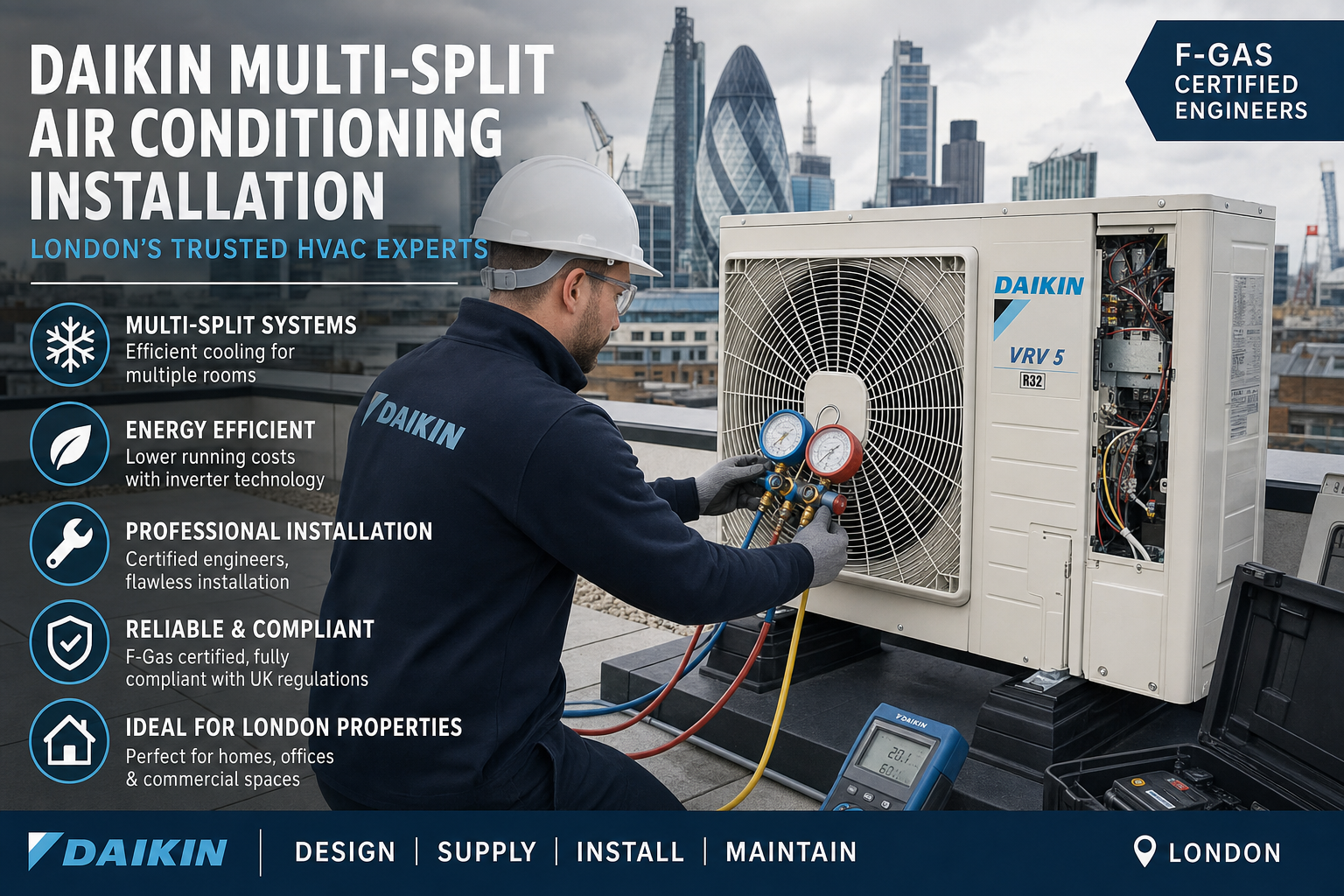
Manufacturer partner tiers determine whether an air conditioning installation receives a standard parts warranty or extended coverage for up to seven years. When evaluating Daikin D1+ air conditioning installers London property owners and facility managers encounter a market divided between general mechanical contractors and manufacturer-accredited specialists. Securing accredited status requires continuous technical audits, direct factory training, and proven project volumes, creating a distinct boundary in installation quality and long-term protection.
In high-density urban areas like London, where plant space is constrained and borough planning departments enforce strict acoustic thresholds, equipment selection is only half of the equation. Correct refrigerant pipe sizing, factory-approved commissioning, and adherence to manufacturer guidelines dictate whether a system operates efficiently or suffers premature component failure. Understanding the requirements of Daikin D1+ certification, along with comparable accreditation schemes from manufacturers like Mitsubishi Electric, ensures that building owners secure genuine equipment warranties and installations that comply with local regulatory mandates.
What Daikin D1+ Status Signifies
Daikin UK structures its network of contractors into distinct tiers based on technical training, financial stability, and installation volume. At the base level, standard trade installers hold mandatory F-Gas certification, allowing them to purchase and handle refrigerant legally. However, they lack direct factory backing or advanced diagnostic support from the manufacturer.
The D1 Business Partner network represents the first formal tier of manufacturer endorsement. To secure D1 status, an engineering business must undergo continuous training at Daikin UK academies, maintain dedicated technical staff, and achieve consistent annual equipment turnover. Daikin conducts procedural reviews of these contractors to confirm that installations follow prescribed piping and electrical standards.
The D1+ Premium Partner and Premier Partner classifications represent the top tier of Daikin accreditation. A Premier Daikin D1+ installer must meet several strict criteria:
- Comprehensive academy training across all direct-expansion product lines, spanning residential split units, multi-split systems, and advanced Variable Refrigerant Volume (VRV) platforms.
- Documented financial standing and minimum annual spend thresholds, demonstrating consistent operational stability.
- Independent site audits where Daikin technical managers inspect pipework layouts, braze quality, pressure testing methodology, and evacuation procedures.
- Company-wide Refcom Elite or equivalent F-Gas registration, verifying strict refrigerant tracking and handling compliance.
- Direct access to Daikin UK senior technical engineers, proprietary selection software, and priority spare parts logistics.
Achieving this level of manufacturer recognition requires an engineering firm to invest heavily in field staff development. When executing complex projects such as multi-room air conditioning systems or large-scale commercial air conditioning installation, this technical backing prevents common design errors, such as improper branch pipe selection, excessive pipe runs that starve evaporators of oil, or misconfigured communications wiring between fan coils and central controllers.
Warranty Extensions: Standard Coverage vs D1+ and Mitsubishi Approval
The most immediate commercial benefit of using an accredited contractor is the warranty duration. Standard trade purchases through HVAC distributors typically carry a baseline manufacturer parts warranty of three years, extending to five years only if the contractor registers the serial numbers through standard trade channels. In contrast, installations delivered and commissioned by a Daikin D1+ partner qualify for an extended seven-year warranty covering replacement parts and compressors.
A similar structure exists across other primary equipment manufacturers. When engaging a Mitsubishi Electric approved installer, particularly one holding Diamond Quality Partner standing, clients unlock warranty terms extending from five to seven years, and up to ten years on selected commercial VRF schemes. These extended warranties reflect manufacturer confidence in the contractor's commissioning practices.
Securing and maintaining these extended warranties requires adherence to specific administrative and maintenance protocols:
- Commissioning data validation: Within thirty days of practical completion, the installer must upload complete commissioning sheets to the manufacturer portal. This data includes running pressures, superheat and subcooling calculations, electrical phase balancing, and total refrigerant trim charges.
- Mandatory maintenance contracts: The equipment must receive scheduled servicing at least once every twelve months by an F-Gas certified technician. High-demand residential or commercial systems running continuous heating and cooling cycles often require biannual servicing.
- Genuine component replacement: Any interim repairs must use original equipment manufacturer (OEM) components sourced directly through approved distribution networks.
Neglecting ongoing air conditioning service & maintenance instantly invalidates these extended terms, reverting the system to statutory minimums. Retaining formal service records protects the property owner if an unexpected air conditioning repair & breakdown occurs years into the operational life of the condenser, shielding them from substantial replacement expenses for inverter boards or scroll compressors.
Why Manufacturer Accreditation Matters for London Properties
London presents unique installation challenges rarely encountered in modern suburban developments. Dense terraced housing, historic building stock, leasehold covenants, and strict municipal oversight demand precise engineering execution. A manufacturer approved AC installation ensures that equipment operates within these demanding local constraints.
Acoustic compliance is a primary obstacle across central and inner London boroughs. Local planning authorities, including Westminster City Council, the Royal Borough of Kensington and Chelsea, and Camden, impose stringent environmental noise policies. External condenser units are typically required to operate at a rating level that is 10 dB below the lowest measured background noise (LA90) at the façade of the nearest noise-sensitive property.
D1+ and manufacturer-approved technicians have direct access to certified third-octave acoustic spectrum data and manufacturer sound-reduction settings. This data allows engineers to model night-quiet modes, specify secondary acoustic enclosures, and calculate the exact sound dissipation path before submitting planning applications. Guesswork or standard catalogue decibel figures regularly lead to rejected planning applications or council noise abatement notices under the Environmental Protection Act 1990.
Physical spatial limitations also challenge London installations. Period conversions and mansion blocks frequently lack external plant space, requiring long, convoluted internal pipe routes. Routing refrigerant lines through ceiling voids and risers requires exact pipe sizing calculations to prevent excessive pressure drops and ensure adequate compressor oil return. D1+ engineers use specialized manufacturer software to calculate line-length penalties and specify external fan coil static pressures accurately.
For high-end residential clients seeking a home air conditioning installation in listed buildings or conservation areas where external condensers are prohibited, accredited partners can specify internal water-cooled condenser systems or concealed ducted units that preserve exterior façades while meeting leaseholder freeholder consent rules.
How to Verify a Daikin or Mitsubishi Partner in London
Contractors frequently use broad marketing terms like "approved" or "specialist" without holding formal manufacturer accreditations. Verifying a contractor's actual accreditation tier requires checking official industry portals prior to issuing contracts or accepting an instant price estimation.
- Search the Daikin UK Partner Locator: Visit the public Daikin UK installer directory and filter results by postcode. Check the badge displayed next to the contractor profile. The directory clearly indicates whether the firm is a general certified installer, a D1 Business Partner, or holds the highest D1+ status.
- Check the Mitsubishi Electric Partner Programme: Navigate to the Mitsubishi Electric commercial or residential partner finder. Confirm whether the company is listed as an Accredited Installer or holds Diamond Quality Partner status.
- Verify F-Gas company registration: In the UK, it is a legal requirement under the Fluorinated Greenhouse Gases Regulations for companies installing split systems to hold a valid F-Gas company certificate. Cross-reference the contractor's registration number on the public Refcom or Quidos F-Gas registers. Individual engineer qualifications are not sufficient; the contracting entity itself must hold company-level certification.
- Confirm subcontracting policies: Clarify whether the contracting firm uses in-house engineers for installation and commissioning. Some brokers market installations under manufacturer badges but subcontract the physical work to unaccredited third parties, invalidating seven-year warranty registrations.
Frequently Asked Questions
What is the difference between a Daikin D1 and a D1+ installer?
D1 Business Partners are approved trade contractors who have completed core Daikin equipment training and maintain a steady baseline of annual equipment purchases. D1+ Premium and Premier Partners operate at a higher volume tier, undergo independent site inspections and technical audits by Daikin engineers, complete advanced training on VRV, heat recovery, and centralized control systems, and are authorized to provide Daikin's maximum seven-year parts warranty.
How much does it cost to install Daikin air conditioning in London?
A single-split system serving a standard bedroom or home office typically costs between £1,800 and £3,000 including equipment, core drilling, pipework, and electrical connection. Multi-split configurations supplying three to four rooms generally range from £4,500 to £9,500. Final project costs depend on pipe route complexity, external scaffolding requirements, internal decoration remediation, and local council planning submissions.
Is it cheaper to repair or replace an older Daikin air conditioner?
If an air conditioning unit is over ten years old, relies on phased-out refrigerants such as R410A or obsolete R22, and suffers a major failure like an inverter board short or compressor burnout, replacement is generally the more economical choice. Modern systems running R32 refrigerant deliver significantly higher seasonal energy efficiency (SEER) ratings. However, systems under eight years old operating on R32 are worth repairing if the parts and labor costs remain below half the cost of a full replacement.
Does Mitsubishi Electric have an equivalent tier to Daikin D1+?
Yes. Mitsubishi Electric operates its Partner Programme, which categorizes contractors into Business Partners, Accredited Installers, and Diamond Quality Partners. The Diamond Quality Partner level is the equivalent of Daikin D1+ status, requiring continuous engineering audits and unlocking extended warranties of seven to ten years on commercial and residential systems.