Expert air conditioning advice
Mitsubishi AC Installation: 2026 UK Guide, Costs, and Regulations
Learn what is involved in Mitsubishi AC installation in the UK: 2026 costs, F-Gas regulations, unit types, and the step-by-step engineering process.
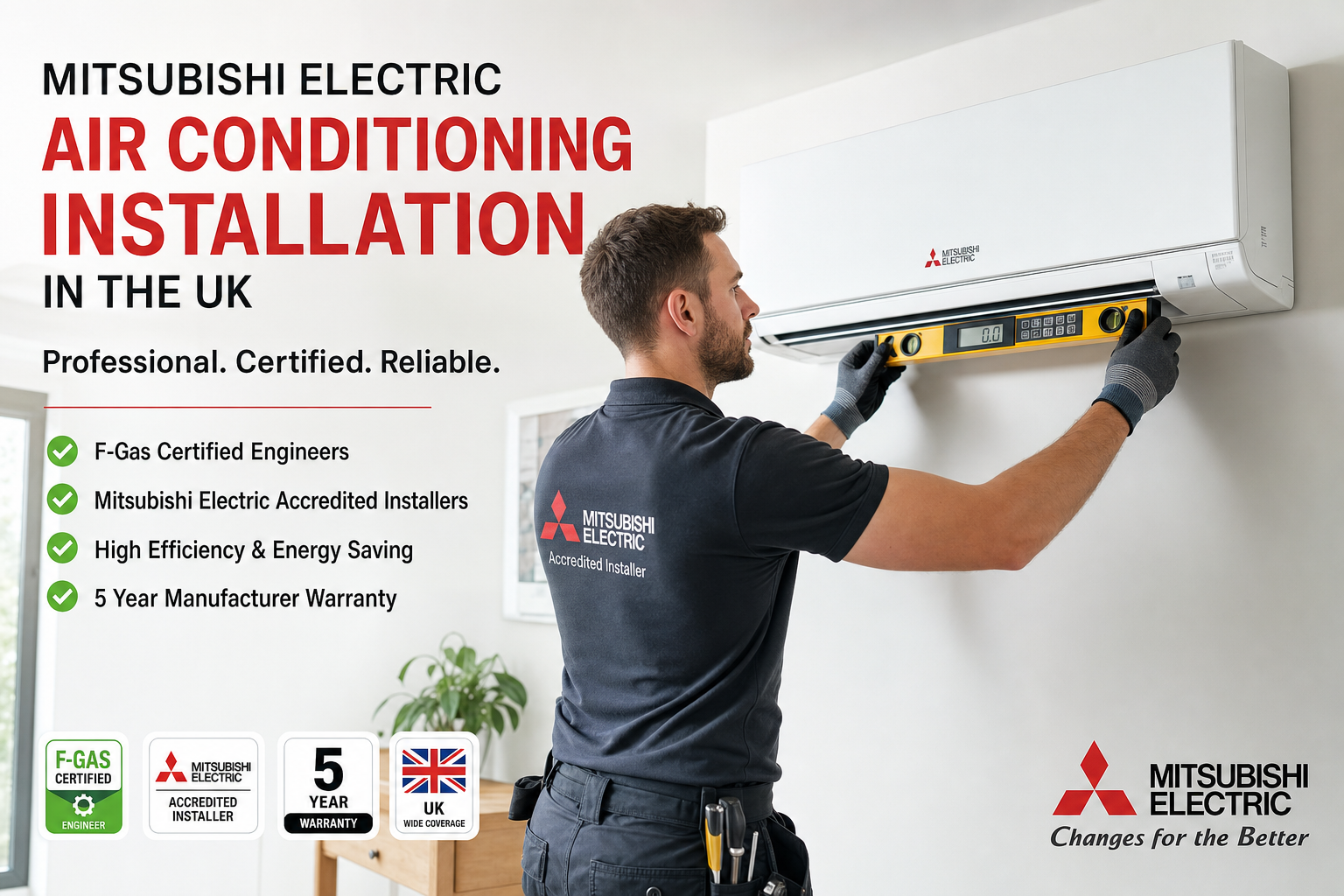
Mitsubishi AC installation in the UK requires mounting an indoor fan coil and outdoor condenser, connecting insulated copper refrigerant pipework, completing electrical interconnections under BS 7671, and vacuum-testing the circuit. UK law mandates that any handling of fluorinated refrigerant must be completed by an F-Gas certified, REFCOM-registered engineer.
This technical and buyer guide explains costs, installation steps, legal requirements, and system selection for UK property owners installing Mitsubishi Electric or Mitsubishi Heavy Industries climate systems in 2026.
What Is Involved in Mitsubishi Air Conditioning Installation?
A standard Mitsubishi AC installation involves mechanically mounting the indoor fan coil and outdoor condenser, core-drilling an external wall, running insulated copper refrigerant lines, connecting electrical interconnects, and pressure-testing the closed circuit. Professional engineers execute these stages to guarantee thermodynamic performance, acoustic isolation, and long-term mechanical reliability.
The indoor evaporator unit mounts to an interior wall, floor, or ceiling void using a steel bracket levelled with millimetre precision. A 65mm to 75mm core hole is drilled through the external building envelope with a slight downward pitch. This pitch ensures gravity condensate drainage without relying solely on mechanical lift pumps. Technicians run a paired set of insulated, refrigeration-grade copper pipes alongside a multi-core communication cable and a flexible condensate discharge hose through this penetration.
Outside, the inverter compressor unit mounts on heavy-duty rubber vibration-damping blocks or cantilever wall brackets. Engineers terminate the copper pipework using calibrated flare joints, pull a deep vacuum below 500 microns to remove moisture, and release factory-charged R32 refrigerant. The installation finishes with electrical certification, connecting a local rotary isolator switch wired directly to the main consumer unit.
How Much Does Mitsubishi AC Installation Cost in 2026?
Mitsubishi AC installation costs in the UK during 2026 average £1,650 to £2,400 for a standard single-split wall unit, including equipment, materials, labour, and VAT. Multi-split configurations running between two and five indoor units from a single outdoor condenser range between £3,200 and £9,800 depending on run lengths and internal layout.
| System Configuration | Capacity (kW) | Typical Property Area | Total Installed Cost (Inc. VAT) |
|---|---|---|---|
| Single-Split Wall Mount (Entry MSZ-HR) | 2.5 kW | Small Bedroom / Home Office (up to 18m²) | £1,650 - £1,950 |
| Single-Split Wall Mount (Mid MSZ-AY) | 3.5 kW | Living Room / Master Bedroom (up to 30m²) | £1,900 - £2,400 |
| Single-Split Premium (MSZ-LN Diamond) | 3.5 kW - 5.0 kW | Open-Plan Kitchen Diner (up to 45m²) | £2,450 - £3,100 |
| Dual-Split System (2 Indoor Units) | 4.0 kW - 5.0 kW | Two Bedrooms / Office and Bedroom | £3,200 - £4,600 |
| Triple-Split System (3 Indoor Units) | 5.4 kW - 7.1 kW | Full Floor / Three Bedrooms | £4,800 - £6,800 |
| Quad to 5-Port Multi-Split System | 8.0 kW - 10.0 kW | Full House / Multi-Floor Coverage | £6,900 - £9,800 |
Equipment supply prices represent roughly 55% to 65% of the total invoice, with certified engineering labour, pipe trunking, bracketry, and electrical feeds accounting for the remainder. Property owners evaluating single installations for suburban semi-detached homes, such as air conditioning in Welwyn Garden City, typically incur lower installation charges due to straightforward back-to-back external wall runs and accessible electrical distribution boards.
By contrast, high-density residential developments, listed properties, and City of London air conditioner installations encounter significantly higher labour charges. Extended internal pipe routes exceeding 15 metres require additional R32 refrigerant top-ups charged by the gram. Running pipework through suspended ceilings, installing secondary condensate lift pumps, and negotiating limited outdoor plant space also increase project costs. Homeowners can use an Instant Price Estimation tool to obtain clear preliminary projections based on room dimensions and external wall proximity.
Legal and Regulatory Requirements for UK Air Conditioning Installation
Air conditioning installations in the UK must adhere to strict environmental laws, building regulations, and electrical safety standards. By law, any trade professional installing, servicing, or commissioning equipment containing fluorinated greenhouse gases must possess individual F-Gas certification and hold active company registration through REFCOM or Quidos.
Section 13 of the Fluorinated Greenhouse Gases Regulations 2015 establishes that handling R32 or R410A refrigerants without City & Guilds 2079 or CITB J11 qualifications is an offence subject to civil penalties. Engaging contractors who comply with F-Gas and REFCOM certification requirements protects property owners from hazardous leaks, validates manufacturer equipment warranties, and provides legally defensible commissioning certificates.
From an electrical perspective, Mitsubishi AC systems require a dedicated radial circuit protected by an appropriate Miniature Circuit Breaker (MCB) or Residual Current Breaker with Overcurrent protection (RCBO) under BS 7671 IET Wiring Regulations. Installers must provide a weatherproof rotary isolator switch adjacent to the outdoor unit. In domestic dwellings across England and Wales, electrical connections to the primary distribution board fall under Part P of the Building Regulations, requiring signed compliance paperwork.
Domestic outdoor condensers normally qualify under Permitted Development rights (Town and Country Planning (General Permitted Development) Order 2015, Part 14, Class G) without full planning permission if specific criteria are satisfied:
- There is no more than one external condenser unit installed on the building.
- The unit sits at least one metre away from the property boundary.
- The installation conforms to MCS 020 sound standards, limiting operational noise to no more than 42 dB(A) at the nearest neighbouring assessment point.
- The condenser is not mounted on a pitched roof or placed within a designated Conservation Area or on a Listed Building without explicit Local Planning Authority consent.
Key Mitsubishi AC Product Ranges for UK Properties
The UK market features systems from two distinct entities: Mitsubishi Electric and Mitsubishi Heavy Industries (MHI). While both originate from the historic Mitsubishi group, they operate completely independent engineering divisions, supply networks, and proprietary control systems across domestic and commercial categories.
Mitsubishi Electric manufactures the market-leading M Series line for residential spaces. The entry-level MSZ-HR series delivers reliable performance with low upfront expenditure. The mid-range MSZ-AY incorporates self-cleaning coils, an A+++ seasonal energy efficiency rating (SEER), and sound pressure levels as quiet as 19 dB(A). For design-focused living rooms, the MSZ-EF Zen and flagship MSZ-LN Diamond series offer finishes in pearl white, onyx black, and ruby red, equipped with 3D i-See thermal sensors that direct airflow away from or toward room occupants.
Mitsubishi Heavy Industries builds the domestic Avanti (SRK-ZSP and SRK-ZS) and Diamond (SRK-ZSX) wall systems. MHI draws upon aerospace engineering to design fan blades that move substantial air volumes with minimal motor turbulence. Both brands function as reversible air-to-air heat pumps capable of producing 4kW to 5kW of heat output for every 1kW of electricity consumed, serving as effective primary heat sources down to outdoor temperatures of -15°C.
Commercial installations rely on Mitsubishi Electric Mr Slim ceiling cassettes and ducted units, or MHI Hyper-Inverter commercial systems. These systems connect directly to central building management interfaces or wireless smartphone platforms, including Mitsubishi Electric MELCloud and MHI Smart M-Air.
The Step-by-Step Mitsubishi Installation Process
Installing a Mitsubishi split AC system follows a precise technical procedure governed by the official manufacturer installation manual. Qualified engineers execute this multi-stage workflow to protect mechanical seals, ensure efficient heat exchange, and preserve compressor reliability.
- Site survey and load calculation: The installer conducts room heat-loss and heat-gain calculations under CIBSE guidelines, sizing cooling and heating capacity based on floor space, ceiling height, insulation quality, and window orientations.
- Indoor bracket mounting: The internal steel mounting bracket is fixed to the wall using heavy anchors, verified with a spirit level to ensure smooth condensate runoff toward the drainage outlet.
- Wall penetration core drilling: A 70mm hole is diamond-drilled through the brickwork or masonry at a downward angle of 5 degrees outward to guarantee natural gravity drainage.
- Refrigerant pipe and electrical containment: Deoxidised, insulated copper refrigerant pipes (typically 1/4-inch liquid line and 3/8-inch or 1/2-inch suction line) are routed alongside four-core shielded communication cabling and rigid PVC drainage piping within architectural trunking.
- Precision flaring and mechanical connections: Pipe ends are cut square, deburred, and formed using eccentric flaring tools. The flare nuts are tightened onto indoor and outdoor brass service ports using a calibrated torque wrench to the exact foot-pounds designated by Mitsubishi engineering specifications.
- Nitrogen pressure testing: The closed pipe network is pressurised with oxygen-free nitrogen (OFN) up to 41.5 bar (4.15 MPa) and held for a minimum of 24 hours or monitored under an electronic manometer to confirm zero mechanical leakage.
- Vacuum evacuation: An F-Gas certified dual-stage rotary vacuum pump dehydrates the system down below 500 microns (0.67 mbar), boiling off any ambient moisture inside the copper pipework.
- Refrigerant release and commissioning: Outdoor service valves are opened with hex keys to release the factory R32 charge. The engineer connects power via the rotary isolator, conducts electrical continuity and Earth loop tests, and tests the unit in cooling and heating modes while measuring supply and return delta temperatures.
What Is the 3-Minute Rule for Mitsubishi Air Conditioning?
The 3-minute rule is an automated safety feature built into Mitsubishi air conditioning logic boards that delays compressor startup for three minutes after a sudden stop or operational mode shift. This delay prevents mechanical failure caused by unequal internal refrigerant pressures.
During normal air conditioning operation, the discharge side of the inverter compressor operates at high pressure while the suction side stays at low pressure. If someone switches the unit off via the remote controller or changes the mode between cooling and heating, high-pressure liquid and gas refrigerant remain unbalanced across the circuit.
Attempting to restart an inverter scroll or rotary compressor against high head pressure forces the electric motor to draw locked-rotor amperage. This can snap mechanical shafts, blow internal safety fuses, or flood the compressor sump with liquid refrigerant, resulting in catastrophic hydraulic lock. The internal microcomputer enforces a mandatory 180-second pause to allow internal system pressures to equalise smoothly through the expansion valve before safely re-engaging the compressor motor.
Choosing an Accredited Mitsubishi Air Conditioning Installer
Choosing an accredited installer ensures your system is fitted to factory standards and gives you access to extended manufacturer warranty coverage. Mitsubishi Electric maintains an established partnership scheme for vetted installation companies, categorised into Accredited Installers and Business Solutions Partners (BSP).
Standard installations carried out by non-accredited tradespeople carry only a baseline one-year to three-year warranty on parts. In contrast, selecting contractors holding formal Mitsubishi Electric partner accreditations increases warranty coverage to five or seven years, and up to ten years through approved Business Solutions Partners. These extended terms cover both the compressor and internal electronics, provided the equipment receives documented annual servicing.
When searching for installation contractors in your area, verify their credentials before signing a contract. Every legitimate installer should supply:
- A REFCOM Company Certificate proving registered corporate F-Gas compliance.
- Individual City & Guilds 2079 Category 1 F-Gas certification cards for all attending engineers.
- NICEIC, NAPIT, or Part P registration proving competent electrical authorization.
- Direct manufacturer partner accreditation certificates bearing a current validation date.
- A comprehensive, fixed-price quote specifying indoor and outdoor model numbers, pipe runs, isolator placement, and warranty terms.
Post-Installation Maintenance and Operational Care
Routine maintenance ensures consistent cooling efficiency, maintains indoor air quality, and prevents avoidable system breakdowns. Neglecting simple upkeep forces the inverter compressor to run at elevated speeds, increasing household electricity bills and shortening equipment lifespan.
Property owners can complete basic filter care every four to six weeks. Unclip the front fascia of the indoor unit, slide out the polypropylene dust filters, and rinse them under warm running water or vacuum off surface dust. Let the filters dry completely in the shade before refitting them. Keep the outdoor condenser clean by clearing fallen autumn leaves, garden debris, and weeds from the exterior aluminium coil faces, maintaining at least 300mm to 500mm of open space around the housing.
UK F-Gas regulations and manufacturer warranty contracts require documented annual maintenance by certified specialists. Professional air conditioning servicing and maintenance includes deep chemical sanitisation of indoor evaporator coils, clearing condensate drains, inspecting electrical isolator terminations, and conducting electronic refrigerant leak checks. Routine service agreements keep cooling and heating cycles running smoothly throughout the year.
Frequently Asked Questions
How much does it cost to install a Mitsubishi air conditioner in the UK?
A standard single-split Mitsubishi air conditioner installation costs between £1,650 and £2,400 including VAT, equipment, and labour in 2026. Multi-room systems covering three to four indoor zones typically range between £4,800 and £8,500 depending on pipework routing, unit capacities, and electrical requirements.
Is it legal to install a Mitsubishi AC yourself in the UK?
It is illegal under UK F-Gas Regulations for an uncertified individual to connect, evacuate, or commission air conditioning pipework containing fluorinated refrigerants. While you may physically screw mounting brackets to an internal wall, an F-Gas certified, REFCOM-registered engineer must connect the copper pipework, vacuum the lines, and release the refrigerant.
What is the difference between Mitsubishi Electric and Mitsubishi Heavy Industries?
Mitsubishi Electric and Mitsubishi Heavy Industries are independent companies that manufacture separate air conditioning ranges. Mitsubishi Electric focuses primarily on residential and commercial building HVAC with its M Series and MELCloud smart systems, whereas Mitsubishi Heavy Industries builds domestic and heavy industrial units using aerospace-inspired fan engineering.
How long does a Mitsubishi split system installation take?
A single-split wall-mounted installation on a back-to-back external wall typically takes four to eight hours. Multi-split systems with three or more indoor units take between two and three full days due to extensive internal pipework routing, trunking installation, and secondary electrical wiring.
Can a Mitsubishi air conditioner heat a home during winter?
Mitsubishi air conditioning systems are reversible air-to-air heat pumps that operate efficiently in winter at outside temperatures as low as -15°C or -20°C. They deliver a Coefficient of Performance between 3.8 and 5.0, producing up to 5kW of heat for every 1kW of electricity consumed.
Do I need planning permission for a Mitsubishi outdoor condenser in England?
Most domestic outdoor units fall under Permitted Development rights if there is only one external condenser, it sits at least one metre from property boundaries, and noise levels stay below MCS 020 limits. Properties in conservation areas, listed buildings, and leasehold flats usually require formal planning permission.
How long do Mitsubishi air conditioning systems last?
Mitsubishi split systems have an expected operating lifespan of 12 to 18 years when maintained annually according to manufacturer standards. Regularly cleaning indoor dust filters and ensuring unrestricted airflow around the outdoor condenser are the most critical factors in compressor longevity.